What is group-type analysis in
fuel testing?
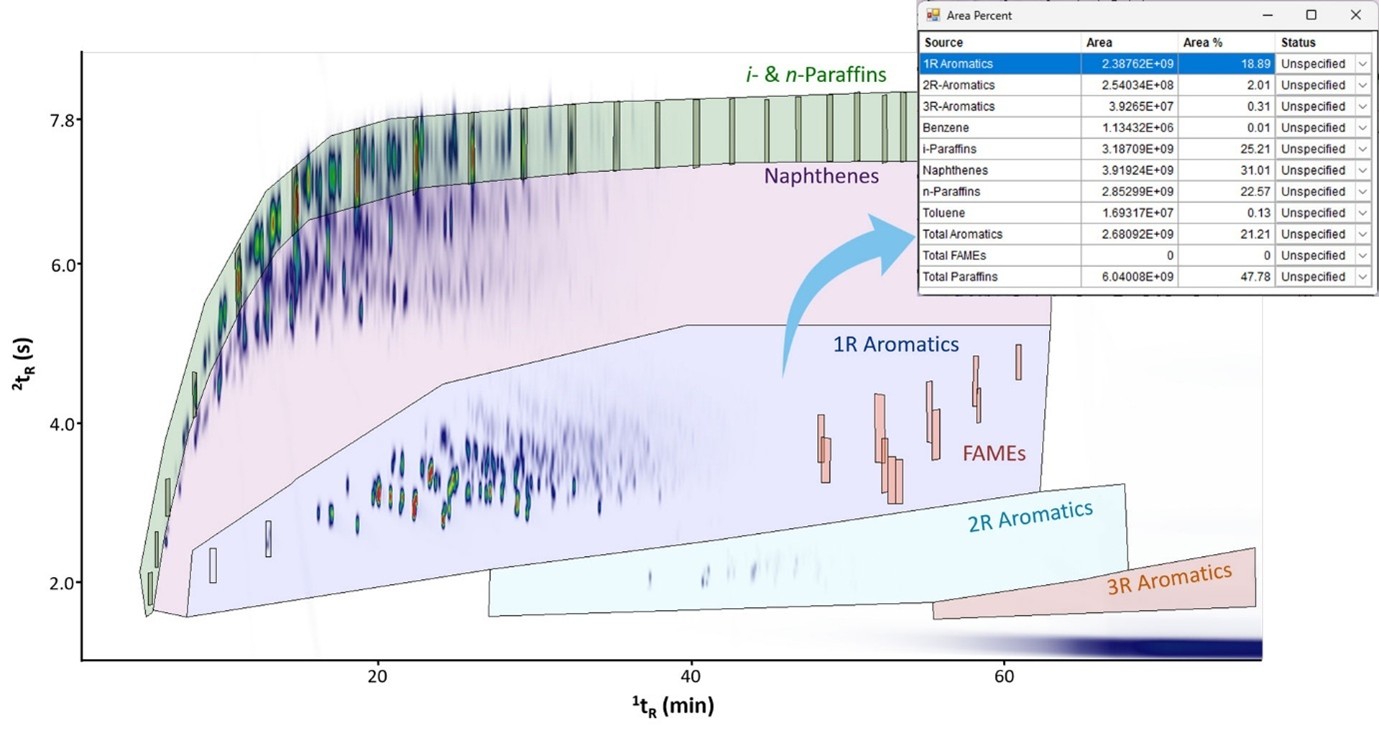
 Group-type analysis is a
streamlined approach for characterising finished fuels like aviation turbine
fuel (AVTUR). Rather than analysing individual chemical components, which can
be complex and time-consuming, group-type analysis focuses on entire classes of
hydrocarbons. This method provides a comprehensive overview of the fuel’s
chemical composition by summing peak areas for different hydrocarbon
groups. ASTM
Method D8396 is a key standard used in this analysis, offering a
simplified and effective way to assess fuel quality.
Group-type analysis is a
streamlined approach for characterising finished fuels like aviation turbine
fuel (AVTUR). Rather than analysing individual chemical components, which can
be complex and time-consuming, group-type analysis focuses on entire classes of
hydrocarbons. This method provides a comprehensive overview of the fuel’s
chemical composition by summing peak areas for different hydrocarbon
groups. ASTM
Method D8396 is a key standard used in this analysis, offering a
simplified and effective way to assess fuel quality.
How does ASTM Method D8396
work?
ASTM Method D8396 specifies
comprehensive two-dimensional gas chromatography (GCxGC) for detailed
hydrocarbon analysis in fuels. This method is particularly beneficial for
middle distillates such as aviation fuel and diesel. By separating hydrocarbons
into well-defined classes, GCxGC enables precise quality control and insight
into the production processes. With the growing importance of sustainable
aviation fuels (SAFs), GCxGC’s ability to provide clear and actionable data is
increasingly valuable. The method’s structured ordering allows for the
straightforward reporting of chemical classes, reducing the need for complex
mass spectrometers or sample fractionation.
Benefits of routine group-type
analysis with GCxGC-FID
SepSolve’s GCxGC-FID offers
enhanced capabilities for routine group-type analysis of middle distillates,
including aviation fuel:
- Enhanced
GCxGC performance: The proven reverse fill/flush design of
the INSIGHT-Flow
modulator is highly regarded in both research and routine
analytical laboratories worldwide.
- Efficient
reporting: ChromSpace
software facilitates rapid data analysis and reporting,
ensuring efficient management of group-type analysis results.
- Increased
productivity: The dual-channel GCxGC setup enables simultaneous
analysis of two samples, effectively doubling throughput.
- Flexible
Integration: The INSIGHT-Flow system can be retrofitted to
popular gas chromatographs, allowing existing GC-FID systems to upgrade
with GC×GC capabilities.