Identifying trace-level aroma-active compounds in foods
and beverages
 The
volatile compounds present in foods and beverages define the sensory
experience, and knowing the exact composition is vital for understanding
consumer preferences and maintaining brand loyalty.
The
volatile compounds present in foods and beverages define the sensory
experience, and knowing the exact composition is vital for understanding
consumer preferences and maintaining brand loyalty.
Within a particular sample, aroma-active compounds from
numerous classes are often present, and these may span a broad range of
concentrations.Conventional GC–MS can struggle with this, with a particular
difficulty being accurately identifying key compounds at trace levels within
complex matrices. Off-odours that negatively impact product perception may also
be missed.
Enhancing aroma and flavour analyses with GCxGC–TOF MS
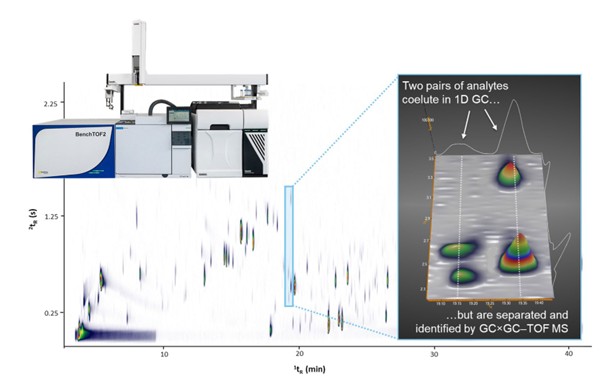
SepSolve’s GCxGC–TOF MS technology, combined with advanced
extraction and enrichment by Centri, addresses these challenges, providing
precise and actionable insights into aroma and flavour volatiles.
Key benefits include:
- Cost-effective,
unattended analysis via cryogen-free, solvent-free
sampling of VOCs and SVOCs in gas, liquid or solid samples using the
Centri platform.
- Unmatched
sensitivity, thanks to the combination of the trap-based focusing and
enrichment of Centri and
the high sensitivity of the BenchTOF2
mass spectrometer. This enables accurate detection and
quantitation of trace volatiles, for better understanding of aroma nuances
and quality differences between products.
- Enhanced
separation by INSIGHT-Flow
GCxGC for deeper insights into aroma composition, enabling
more accurate brand comparisons and accelerating the development of new
flavourings.
- Reliable
identification thanks to the excellent spectral quality and mass accuracy
of BenchTOF2. This capability is further enhanced by the complementary
spectra for similar isomers provided by Tandem
Ionisation, ensuring confident identification of challenging
compounds.
- Quick
chromatogram comparison enabled by ChromCompare+
software, for easy assessment of brand differences and the
identification of odour taints
- Flexible
configurations to address your application needs, including the addition
of sensory evaluation with GC–O or
parallel detection using different techniques, such as FID or SCD.